
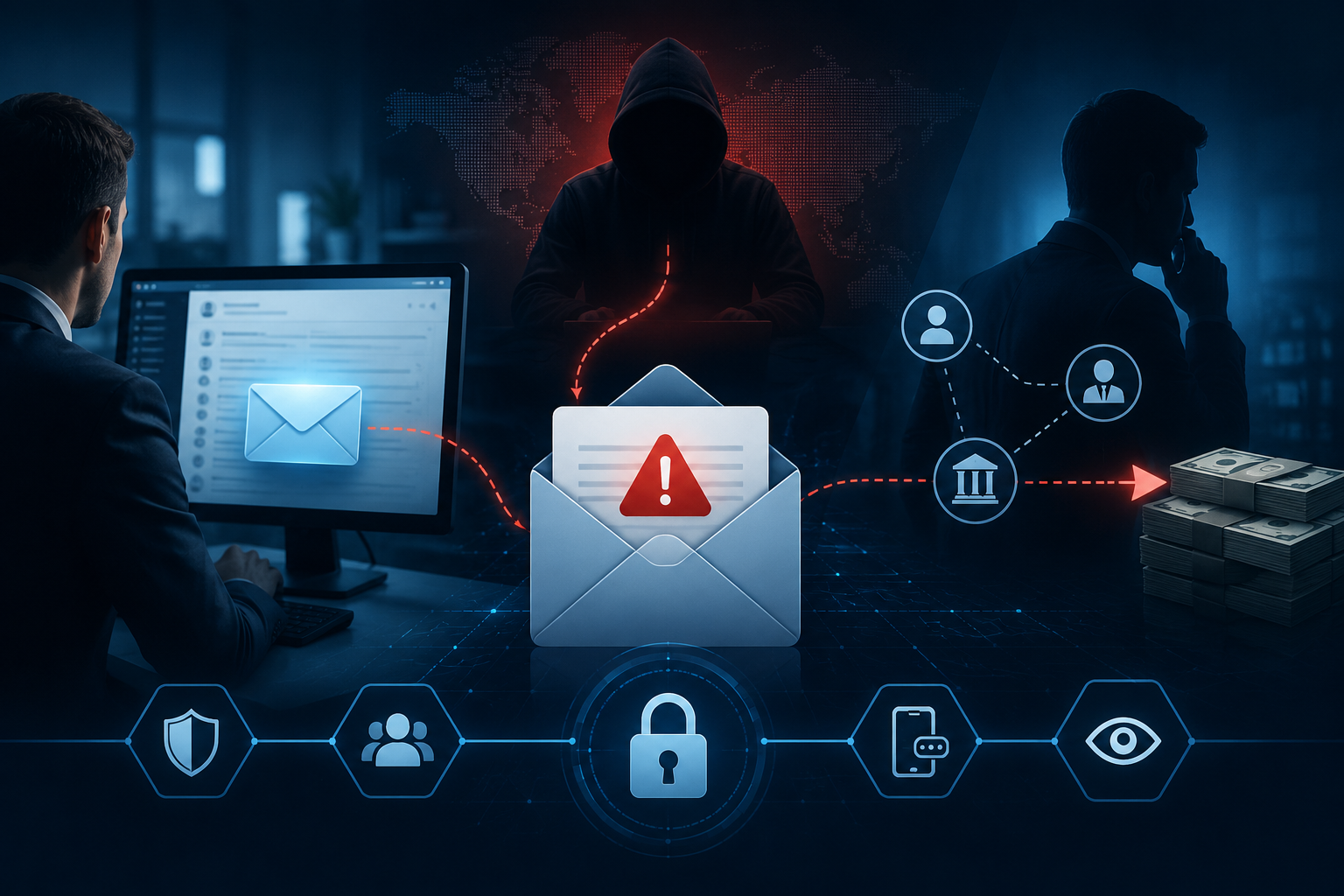
Business Email Compromise (BEC) has become one of the most financially damaging forms of cybercrime. Unlike traditional phishing attacks that rely on malware or malicious links, BEC attacks often exploit trust by impersonating executives, vendors, or trusted business partners to convince employees to take unauthorized actions.
A typical attack may involve an email requesting an urgent wire transfer, changes to vendor payment information, or access to confidential documents. Because these requests often appear legitimate and originate from compromised or spoofed accounts, they can easily bypass traditional email filtering solutions.
The success of these attacks depends on human behavior rather than technical vulnerabilities. Cybercriminals research organizations, study employee roles, and monitor public information to craft highly convincing messages. As remote and hybrid work environments continue to grow, employees have fewer opportunities to verify unusual requests in person, increasing the effectiveness of social engineering attacks.
Reducing BEC risk requires a combination of people, processes, and technology.
Organizations should establish verification procedures for financial transactions and sensitive requests. Any request involving payment changes, wire transfers, or confidential information should require independent verification through an approved communication channel.
Security awareness training should also emphasize recognizing urgency, authority, and emotional manipulation, common tactics used in social engineering. Employees who understand these warning signs are more likely to question suspicious requests before acting.
From a technology perspective, organizations benefit from solutions that evaluate communication context rather than simply scanning for malicious content. Behavioral analytics, identity monitoring, and anomaly detection can identify unusual activity that traditional email filters may overlook.
Strong identity controls further reduce exposure. Multi-factor authentication, privileged access management, and continuous monitoring for compromised accounts help prevent attackers from gaining access to legitimate business email accounts.
Finally, organizations should regularly review their incident response plans to ensure teams know how to investigate suspicious communications, recover compromised accounts, and notify affected parties quickly.
As cybercriminals continue refining their techniques, defending against BEC requires moving beyond traditional email filtering toward a comprehensive strategy focused on identity, behavior, and user awareness.
How CyberGrade Can Help
We specialize in helping organizations navigate the complexities of remote work security. Our vendor-agnostic approach allows us to assess your unique needs and recommend tailored solutions to mitigate cybersecurity risks effectively.